on
In this article,
- What exactly the BMWK report is about,
- how older people can contribute to solving the problem,
- why we should look to NASA as a role model,
- that companies and interim management providers need to rethink,
- what companies need to change in order to benefit from working with external professionals,
- Why interim management providers need to modify their price and contract models
- why they are suitable strategic HR partners for companies.
Demographic change: shock or opportunity?
on
In this article,
- What exactly the BMWK report is about,
- how older people can contribute to solving the problem,
- why we should look to NASA as a role model,
- that companies and interim management providers need to rethink,
- what companies need to change in order to benefit from working with external professionals,
- Why interim management providers need to modify their price and contract models
- why they are suitable strategic HR partners for companies.
Germany is becoming an old man. The fact that we are in the midst of demographic change - no problem! The Scientific Advisory Board of the Federal Ministry of Economics and Climate Protection (BMWK) warned that we are not well enough prepared for the demographic shock in its report Gesamtwirtschaftliche Herausforderungen durch den demographischen Wandel, which was presented on December 4, 2024. The key message: the scope of the economic consequences associated with demographic change is "still underestimated". At the same time, the Scientific Advisory Board states that older people are not just part of the problem. They can also contribute to solving it. If we change the way we deal with this population group on the labor market, this opens up a great opportunity for Germany as a business location.
What exactly is the BMWK report about?
The independent report, which was presented by the Scientific Advisory Board of the Federal Ministry of Economics and Climate Protection in December 2024, deals with the overall and real economic effects of demographic change. On the one hand, the working population is becoming increasingly smaller. On the other hand, this means that the output of goods and services will also decrease - forcing companies to increase their prices due to rising costs. In addition, the younger generation will have to generate large parts of the social product and "increasingly share this with the older generation, which will probably be accompanied by a higher tax and contribution burden on the younger generation. It is also likely that spending that benefits younger people (e.g. education, investments) will be crowded out by social spending in favor of older people."
The forecast therefore looks bleak. Even a significantly higher birth rate would not change this situation in the next 20 years. The immigration of well-educated migrants and their integration into the local labor market could provide relief, but is not a real solution, "because immigration would have to be unrealistically high". Or in figures: For the year 2025, the Scientific Advisory Board assumes that 1.25 million people will retire. At the same time, however, only around 850,000 people will enter the labor market. There will only be marginal changes to this imbalance in the coming years. And the gap between people leaving the workforce and younger people entering it will continue to widen.

Number of people in employment and pensioners (in millions) over time. Source: Report "Macroeconomic challenges posed by demographic change"; © Deutsche Interim AG
How can older people contribute to solving the problem?
According to the report, it is obvious to use "the currently untapped workforce potential of older people, younger people, women and migrants". A look at Sweden shows that older people in particular could contribute to a significant relaxation on the labor market. Although Germany has "already made great progress in exploiting the labor force potential of older people", our Scandinavian neighbors demonstrate how this can be done even better. If we had the same number of people aged between 55 and 64 working here as in Sweden, we would have around 440,000 more workers. This alone would close the gap between those leaving the workforce and those entering it. And if we had the same employment rate in the over-65 age group in this country as Sweden, there would be an additional 900,000 workers available. The potential is therefore enormous. According to the report, politicians are called upon to further reform the state pension. Sweden, for example, has a higher standard retirement age, which automatically increases with life expectancy. At the same time, there are no concepts such as partial retirement or "retirement at 63".
Professionals and managers are getting older and retiring
As you may know, I have been dealing with this issue myself for some time - and am working with my team at Deutsche Interim AG on practicable and pragmatic solutions. But back to demographic change. By 2022, the baby boomers, i.e. those born in the mid-1950s to late 1960s, will be the largest age group in Germany with around 14 million. It is the course of events that baby boomers gradually retire from working life. Or in figures: By 2036, 12.9 million working people will retire (as of 2022). This corresponds to around 30 percent of the workforce.
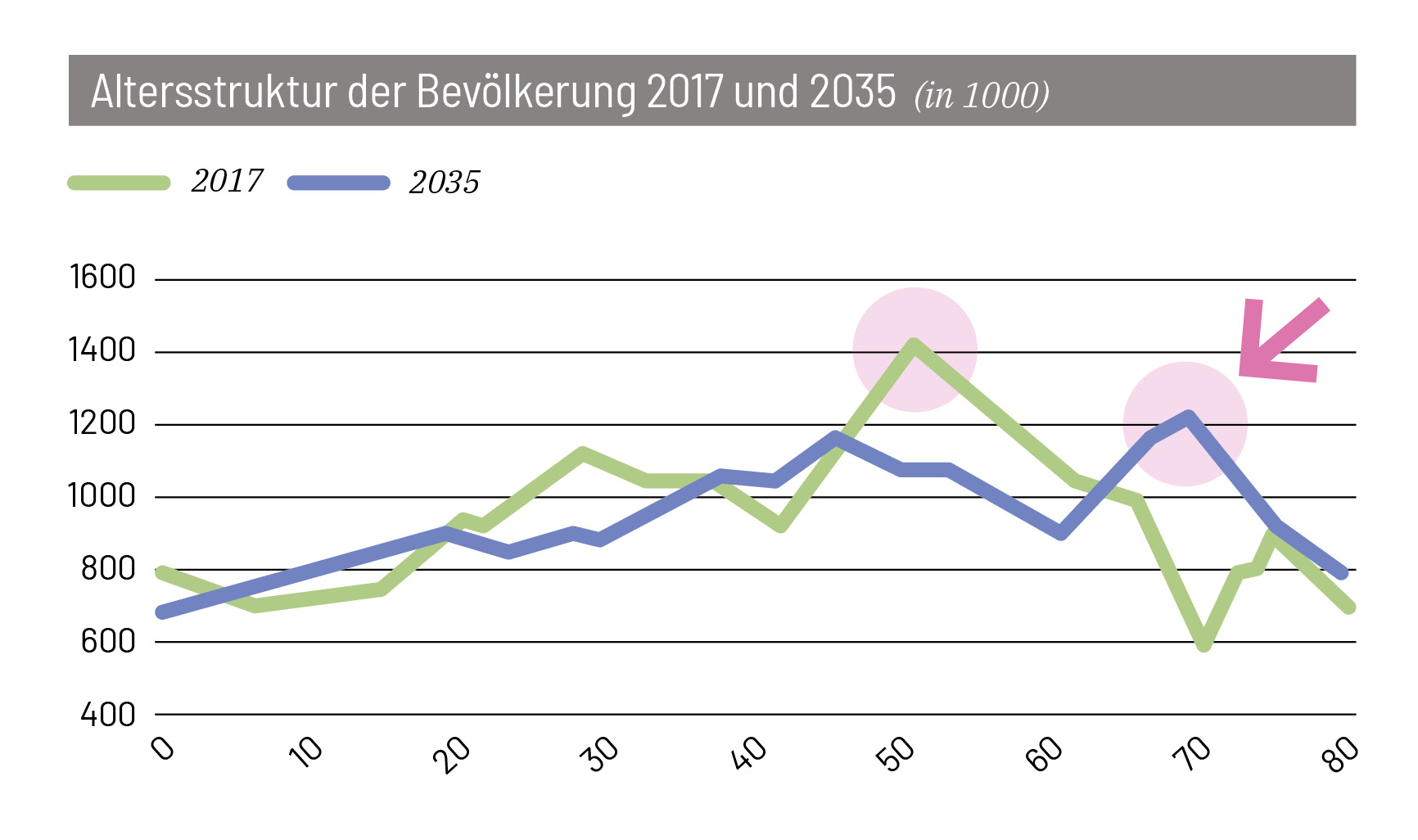
The baby boomer bell shifts backwards. © Deutsche Interim AG
Of course, there is a relevant number of people among these almost 13 million who held a management position at the time of their retirement. However, the data situation here is not clear. According to statistics from 2018, more than half of all managers in German companies were older than 50 at the time. 17 percent were even between 61 and 70 years old. The study Route of the Top 2021 shows that German companies are predominantly headed by men aged 55. The German Economic Institute, on the other hand, presents different figures. According to the IW Report 16/2024, managers in Germany are 43 years old on average. Has a demographic-related rejuvenation already taken place in the period from 2018 to 2024?
The following still applies: to hold a leadership position, a certain amount of experience is usually required - regardless of whether the person is 43 or 55 years old on average, male or female. If these people from top management, middle management or as highly qualified specialists gradually retire from active professional life, companies have to do without their extensive wealth of experience. However, experience and expertise do not necessarily have to be lost.
Why should we take NASA as a role model?
NASA's astronauts were not only the first people on the moon. NASA also shows that working together with experienced retirees brings great added value. As the weekly newspaper "Die Zeit" reported in April 2024, NASA has reactivated retired employees to repair the Voyager 1 space probe so that it can send usable information back to Earth. The same applies to the ongoing maintenance and repair of the Hubble Space Telescope, which has been providing images from the depths of space since 1990. NASA regularly relies on retired experts with extensive expertise and many years of experience. Some of these "retired specialists" have helped design key systems of the telescope and therefore play an important role in troubleshooting and problem solving.
I ask myself: why don't German companies take NASA as an example?
In my opinion, we - and by that I mean German companies - have no choice but to harness the potential of older people. Or to paraphrase Angela Merkel: there is "no alternative" to working with retired professionals. And this is where we come into play as an Interim Management Provider. Because we can be the partner who places the needed specialists and managers with companies. And yes, this explicitly includes people aged 50+, 60+ or even 70+.
Companies and interim management providers alike must rethink
In order for us to fulfill our function as a partner to the German economy, two premises must be fulfilled.
- Companies recognize the benefits of working with external specialists and managers.
- Interim management providers are developing more "permeable" pricing and contract models.
What do companies need to change in order to benefit from working with external professionals?
In order for companies to benefit from working with interim managers, they first need to create the right framework conditions. This includes not only rethinking in many areas, but also implementing practical measures.
Modernizing corporate culture
Many companies are currently experiencing that they are no longer able to fill vacancies. In many places, companies are looking for staff for permanent positions. But instead of sticking to this "we've always done it this way", it could be an option to explore new ways of recruiting and think collaboration not in terms of personnel, but in terms of expertise. One example: If you want to move your entire IT infrastructure to the cloud, you don't have to put a project manager in a permanent position in charge - whether the person is from your own ranks or hired specifically for this purpose. There are highly qualified professionals who specialize in precisely this task. They come into the company for a certain period of time, implement the project, bring it to a successful conclusion and then leave the company again. However, companies - including their permanent staff - must want an external person to familiarize themselves with processes in such depth. And they have to create appropriate structures and workflows. How well all this works is a question of corporate culture.
Making workforce organization more flexible
Today, and even more so in the future, companies that make their personnel planning dynamic and needs-based will have a competitive advantage. Those who have an integrated HR strategy and are able to deploy both internal and external personnel based on skills can react more flexibly to changing market requirements and unforeseeable events. For example, companies can reduce personnel costs during a crisis by working less intensively with freelancers. These in turn have the opportunity to make their expertise available to other companies. This allows companies to reduce personnel costs without having to lay off permanent employees.
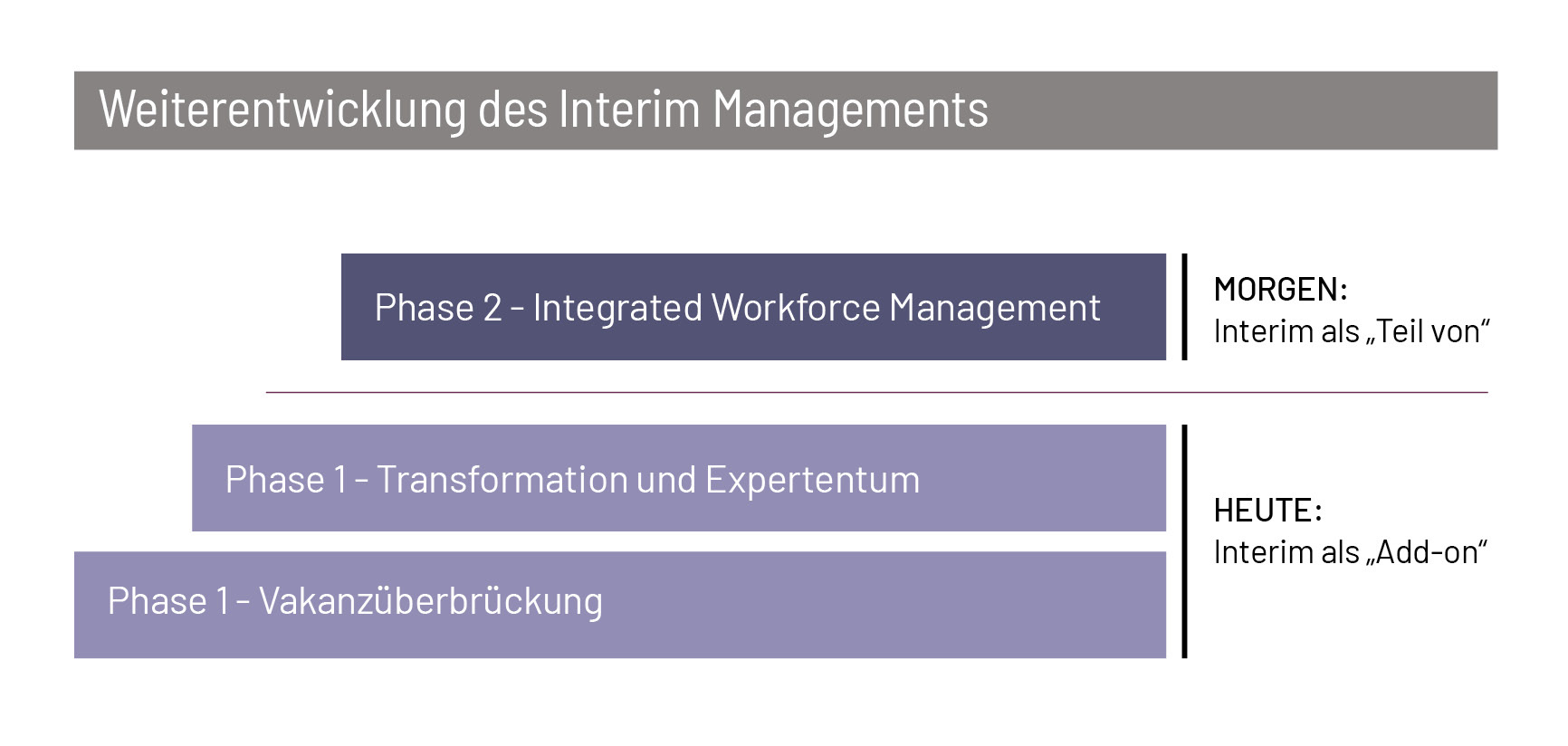
Interim management is developing from an "add-on" into an integral part of the HR strategy. © Deutsche Interim AG
Introducing modern HR management concepts such as Connected Workforce
In view of the shortage of specialists and managers, there can be no more waiting. Companies must now look at innovative concepts for modern HR management. To do this, they must first critically scrutinize their own HR strategy and be open to new approaches such as the Connected Workforce. Our concept is based on the fundamental assumption that the boundaries of traditional employment models are continuing to dissolve. The aim is to rethink and reorganize collaboration in teams. In practical terms, this means that instead of trying to recruit only permanent employees for a job, companies should select their employees based on whether they are professionally qualified to perform a specific task. Regardless of whether they are permanent employees or freelancers.
In essence, the connected workforce is about nothing more, but also nothing less, than forming a networked workforce of permanent and freelance employees. The more effectively permanent staff and freelancers work together, the better the results can be expected.
Why interim management providers need to modify their pricing and contract models?
It's not just companies that need to make their workforce management more flexible and agile. Interim management providers are also required to create new contractual bases for the commissioning of interim professionals. I am of the opinion that other price and contract models are needed in addition to the traditional mandate. I see the following options here:
Interim project
Task of the interim professional: Consulting a company with regard to a specific challenge
Advantages for companies:
- Immediate access to experienced experts with extensive expertise
:inside with great expertise
- Support in the development of strategies and concepts
- Decision-making support
- Access to proven best practices
Duration of the interim project: maximum six months
Interim mandate
Task of the interim professional: Development of a solution for a specific challenge and support in operational implementation
Benefits for companies:
- Immediate access to experienced specialists and managers with extensive specialist knowledge
- Possibility to, react quickly to changes and new challenges
- High flexibility
- Cost certainty
Duration of the interim mandate: up to twelve months
Interim mission
Task of the interim professional: Development of a solution for a specific challenge and support in operational implementation
Benefits for companies:
- See Interim mandate
- Possibility to successfully complete stalled, business-critical projects (e.g. transformation of the business model, transformation of the business model, transformation of the company structure, etc.). E.g. transformation of the business model, conversion of production in line with Industry 4.0, etc.)
Duration of the interim mission: up to 18 months
Fixed-term permanent position
Task of the interim professional: Ongoing support in developing a solution for a specific challenge as well as support in operational implementation and ongoing optimization
Benefits for companies:
- Long-term access to specialist expertise
- As part of the core workforce, the professional is structurally, organizationally and strategically fully integrated into the company and all processes
- Possibility to prepare, implement and follow up on particularly extensive projects with fundamental changes from a single source (e.g. development of a sustainability strategy, development of a sustainability strategy for the company). E.g. development of a sustainability strategy and gradual implementation of measures in all areas of the company)
- Planning security
- Fixed salary
Duration of the permanent employment: up to 24 months
Why are interim management providers suitable strategic HR partners for companies?
As an interim management provider, we have not only developed a concept with the Connected Workforce that gives companies the opportunity to close personnel and professional gaps without permanent employees. We also have an extensive database of independent, highly qualified and motivated specialists and managers. A relevant number of them have already passed the age of 50 or even 60. Let's think back to the scientific report: We need precisely those people to close the demographic gap in the labor market. We can provide these important professionals. It is up to companies to take action.
Want to find out more about the Connected Workforce concept? Download our compact brochure now for free!