on
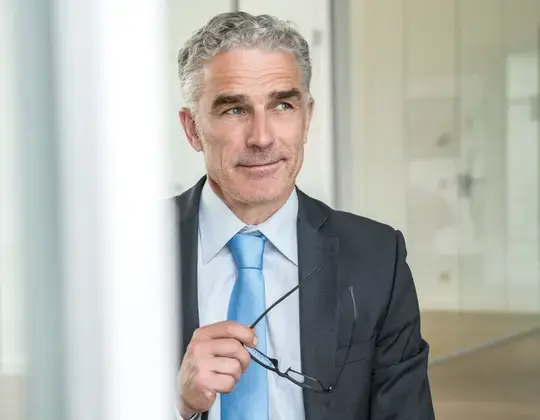
Interview with Tilo Ferrari: Rethinking collaboration with the Connected Workforce
on
Demographic change is threatening the performance of our economy and the prosperity of society as a whole. We need a successor to the successful "baby boomer" model: the connected workforce could be a solution. In this interview, Tilo Ferrari, CEO of Deutsche Interim AG, explains what the connected workforce is all about and why the "networked workforce" is a practicable solution to the shortage of specialists and managers. The questions were asked by editor Charly Kahle.
Dear Tilo, the term "connected workforce" is used in different ways. It often refers to the networking of people and machines in production, but also to the organization of work in companies. What do you mean by this?
Tilo Ferrari: When we talk about demographic change and a shortage of skilled workers, the next step is the much-cited "war for talent". This is not only an ugly term, but also an approach that we should rethink. We don't need a war, and we certainly don't need a war for talent. We need a change - towards flexible and needs-based methods of recruitment.
The labor market is transforming: this is challenging. But the change also offers opportunities. If we succeed in establishing new concepts for the world of work today, we will benefit tomorrow. My interpretation of the connected workforce goes beyond the previous definition. For me, it's about shaping a new work culture and creating a network at the heart of it that benefits business and people alike.
What that means in concrete terms?
TF: We need companies and work organizations that don't compete with each other for expertise, but instead use skills efficiently and flexibly. Specialists should not be hoarded, but should be able to pass on their knowledge to many others. This is one of the guiding principles of the Connected Workforce.
Why should companies be interested in sharing skills according to the Connected Workforce model?
TF: I am firmly convinced that the economy will have no choice but to make flexible use of increasingly scarce personal resources. There is nothing wrong with specialists moving on after a project and solving the next problem somewhere else. It's a bit like car sharing: 90 percent of cars are empty in the parking lot. Theoretically, the demand for mobility could be met with ten percent of the vehicles - if the cars were always where they were needed. In this sense, the connected workforce is a model that competently serves the needs of the working world with a significantly smaller headcount.
Economy is competition: do you really think that companies will get involved in it?
TF: I see signs of this. For example, the acceptance of interim management is increasing in companies - and more and more people can imagine working for themselves. We can already see today that many specialist skills are only available to a very limited extent. This will get worse. That's why we need to rethink: it's not a question of wanting to, but simply a necessity. We will have to share existing capacities more flexibly in order to maintain Germany's competitiveness as a business location.
At the same time, the principle of a networked workforce is cost-effective. Clients will only pay highly qualified specialists and managers on a temporary basis instead of hiring them permanently. And the direct and indirect costs for lengthy recruitment processes are also eliminated.
So far, we have mainly talked about the employer side. What changes will the connected workforce model bring for employees?
TF: That's right. We will certainly all have to learn a lot of new things together. The traditional model of permanent employment is already disappearing more and more. People of all ages are looking for alternatives that give them more room to fulfill their personal and professional life goals. That's why freelancers are a key pillar in my understanding of the connected workforce: we should encourage freelance work and create models that allow more people to participate in the labor market as self-employed people according to their own ideas.
And where should the many new freelancers come from?
TF: I'm thinking, for example, of young people, parents or people who still want to work at 60 plus. If we manage to integrate these groups into the labor market according to their ideas, we will have already gained a lot. For students today, the model of the self-employed is often more present than ever. Many educational institutions have adapted their curriculum and support people who see their professional life as a start-up from the outset, so to speak. Companies have also recognized this and are promoting the "entrepreneur within the company" with special programmes.
Who else is eligible for the connected workforce?
TF: The connected workforce addresses - in addition - many other groups of people. I'm thinking, for example, of employees over 50 who can no longer or no longer want to end up in the traditional employment grid. Another group of people: people who no longer need to work for economic reasons but would like to continue to contribute their skills. The proportion of highly qualified people between 60 and 64 who are in employment has increased by half over the past ten years to 74%. The proportion of self-employed people over 65 is around a third, but only a meagre eight percent on average across society. There is still a lot of room for improvement. There is enormous potential in these groups.
📖 READING TIP 📖
In our article Connected Workforce: Concept for modern HR management, we take a detailed look at the causes of the shortage of specialists and managers - backed up with impressive figures - and provide recommendations for action.
What would be necessary to leverage the potential?
TF: In order to meet the challenges of demographic change on the labor market, existing labor market policies need to be adapted. That is my firm conviction. Let's take bogus self-employment and compulsory social insurance as examples. In interim management, it is not uncommon for specialists and managers to work on a project for up to two years. If they have no other income from self-employment during this time, they are at risk of being classified as bogus self-employed. The worst thing about this is that bogus self-employed persons are subject to social security contributions. The additional payments for pension and unemployment insurance alone can run into six figures - and ruin the economic existence of those affected. Legislators are called upon to create clarity with a simple system. Some of our European neighbors, in particular Austria and Switzerland, are setting a good example and have created pragmatic solutions for self-employed people with regard to compulsory social insurance. I definitely see a need to catch up here in Germany.
What is your personal agenda when it comes to the connected workforce?
TF: As the CEO of a company that offers flexible staffing solutions, I see the need to respond to demographic change with new ideas. As Deutsche Interim AG, we are already working hard to support people on their path to self-employment - and to get companies excited about the possibility of needs-based staffing solutions and a networked workforce. As an entrepreneur and citizen, I am involved in various associations and initiatives to encourage more people to become self-employed and more companies to work with networked freelancers.
Are you interested in the connected workforce? Then download our Brochure Connected Workforce: With Interim Management to a Connected Workforce for free and tell your colleagues about it.