on
In this article you will learn:
Everything you need to know about freelancers - and what you probably didn't know yet
The freelance business is booming. In times of an increasing shortage of skilled workers, more and more companies are turning to freelancers - either to bridge temporary staff shortages or to have certain tasks performed by external service providers on a permanent basis. But what exactly is a freelancer? Are there differences between freelancers and independent contractors? What does a freelancer cost? How can you become a freelancer? How do you get freelance jobs? What are the advantages of hiring freelancers? And are interim managers actually freelancers? Questions upon questions that we are happy to answer for you. There's also an anecdote to make you smile. We promise!
Definition: What is a freelancer?
Freelancers, also known in this country as freelancers or freelance employees, are self-employed people who take on individual assignments from companies and other clients or are involved in the operational implementation of projects. In contrast to permanent employees, freelancers work on their own account. Freelancers do not usually delegate the tasks assigned to them to employees, but carry them out themselves. The employment relationship between the freelancer and the client is usually governed by a work or service contract.
💡 Good to know 💡
The term "freelancer" was coined by the British author Sir Walter Scott (1771 - 1832). He used it in his novel "Ivanhoe", published in 1820, to describe medieval mercenaries. According to this, a "freelancer" is a kind of lance bearer who is not bound to a liege lord, but chooses independently in whose service he places himself (free).
What distinguishes freelancers and freelancers?
Whether and what differences there are between "freelancers" and "freelancers" depends on the language. In English, all workers without a permanent position are considered freelancers. It is completely irrelevant whether freelancers take on temporary projects as gig workers or, for example, work as CROs on a temporary basis in an international corporation. German, on the other hand, distinguishes between "Freelancers" and "Freiberuflern". Not all freelancers are also freelancers, as there are certain activities in Germany that are defined as "liberal professions" in accordance with Section 18 I No. 1 EStG. According to this, freelancers provide self-employed scientific, artistic, literary, teaching or educational services in their jobs and are not a trade and are not subject to trade tax, but are often subject to sales tax.
As soon as a freelancer works together with professionally trained workers, caution is advised. This is because the person is only considered a freelancer if they continue to work operatively and independently despite their management function. Typical examples are doctors who treat patients and employ a practice team. If, on the other hand, the freelancer's activities are limited exclusively to managing and organizing the practice, doctors are no longer considered freelancers, but tradespeople.
What distinguishes freelancers?
The characteristics that distinguish a freelancer's work are usually as follows: Freelancers are
- self-employed,
- not bound by instructions from their client,
- not subject to social security contributions,
- usually highly qualified or specialized,
- employed by various clients,
- working on own account (hourly or flat-rate) and
- not bound to fixed working hours and locations.
What tasks do freelancers take on?
Typical tasks for freelancers are particularly in specialist areas such as
- IT: e.g. software development
- . E.g. software development
- Accounting: e.g. preparation of payroll accounting. E.g. preparation of payroll accounting
- Controlling: e.g. commercial project management
- Purchasing: e.g. Market analysis, procurement planning
- Human resources: e.g. employee coaching
- Sales: e.g. Creation of sales concepts
- Marketing: e.g. content creation, social media management, graphic design
What does a freelancer cost?
According to Freelancer Compass 2023, the average hourly rate for freelancers in the DACH region is around 100 euros. At 99 euros per hour, freelancers in Germany receive slightly more than in Austria (97 euros). In Switzerland, the average hourly rate is 134 euros.
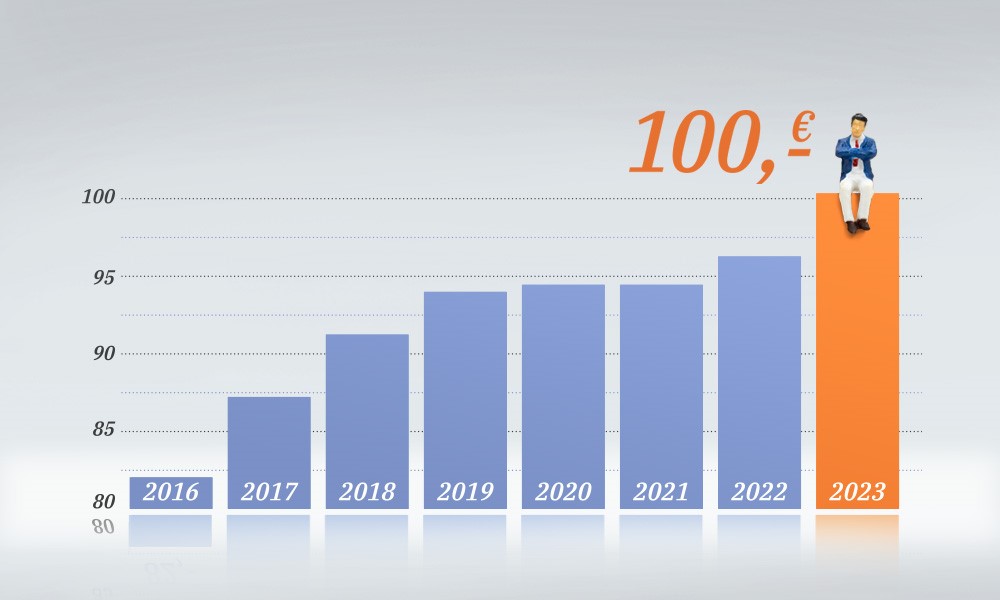
Development of freelancer hourly rates from 2016 to 2023. (Source: freelancermap; Copyright: Deutsche Interim AG)
The highest hourly rates of 119 euros are achieved by SAP experts, managers and consultants. IT infrastructure specialists (94 euros), freelancers specializing in development, tech and data (93 euros), marketing and communication professionals (86 euros) and engineers (86 euros) follow slightly behind. Specialists in graphics, content and media bring up the rear (€62).
In addition to the specialist area, there are other factors that influence hourly rates:
- Professional experience/age
- Role in the project
- Branche
- Unternehmensgröße
- Region
- Bildungsabschluss
- Gender
How do companies benefit from freelancers?
The biggest advantages for companies that employ freelancers are certainly the more flexibility and specialist expertise that they gain as a result. Companies can reinforce themselves temporarily or permanently with experts who specialize in certain tasks - whether as part of a temporary project or for regular tasks in certain departments. It is important that freelancers work hand in hand with the permanent staff. Those who succeed in professionalizing flexible workforce management will benefit in several ways: Because such companies
- fill staffing gaps more quickly,
- are attractive employers,
- absorb capacity peaks and fluctuating workloads,
- expand technical expertise,
- improve the quality of work,
- increase their resilience and
- set themselves up for the future.
Of course, this comes at a price. Because - in terms of hourly wages - freelancers are generally more expensive than permanent employees. In return, companies take a lower risk with freelancers - precisely because they are not permanently tied to them. In addition, companies don't have to pay social security contributions and are not bound by the provisions of employment protection.
Are interim managers freelancers?
Yes, by definition, interim managers are freelancers. However, most interim managers do not consider themselves to be freelancers, but rather freelancers - even if they are not. Unless they belong to the liberal professions. In fact, the term freelancer is often used in Germany to differentiate them from interim management. While freelancers generally perform operational tasks, interim managers take on complex and strategically oriented management tasks - up to C-level and general management positions. Interim managers are therefore highly qualified and very experienced freelancers who provide their clients with valuable support in their respective area of specialization for a certain period of time.
📽️ Video tip 📽️
In his review of the Flexible Workforce Summit, which took place in Copenhagen at the end of March 2023, Tilo Ferrari takes up the freelancer thread and spins it further.
How to become a freelancer
Those who want to become freelancers must first fulfill one essential requirement: The person must be professionally qualified and ideally specialized in a specific activity or a defined subject area. Whether a freelancer is active as a freelancer or a tradesperson depends on the type of service he or she provides. Anyone who wants to become a freelancer and is toying with the idea of taking on freelance jobs as an interim manager should make this decision very consciously. After all, working as an interim manager is not right for everyone.
📖 Reading tip 📖
In our Brochure Connected Workforce: With Interim Management to a Connected Workforce you can learn more about the causes of the shortage of specialists and managers, why the connected workforce is a promising solution and what role freelancers play in this.