on
Don't wait and see, start pragmatically with ESG right away
on
ESG criteria and sustainability reports are becoming increasingly relevant for companies - including small and medium-sized enterprises. Often described in the media as a bureaucratic nightmare, many companies shy away from tackling the complex issue of sustainability. But is it really all that complicated? We asked Karolin Rohmer, ESG expert and interim manager for sustainable product and innovation management. In this expert interview, she reveals how SMEs can navigate the regulatory jungle, how they can get off to a pragmatic start with ESG and what competitive advantages result from this.
Mrs Rohmer, anyone who deals with sustainability quickly comes across abbreviations such as GRI, ESG and CSRD. Can you shed some light on this jungle of abbreviations and explain what they are all about?
Karolin Rohmer: The topic of sustainability gained a foothold in the public eye several decades ago. The initial spark came in 1997 with the "Global Reporting Initiative" (GRI), which has since become a common standard. Little happened in the years that followed. Only recently, in the last ten years or so, has the wheel started turning faster again. At the moment, there is a feeling that things and especially the shortcuts in terms of sustainability are coming thick and fast. Particularly noteworthy are the three letters ESG, which stand for "Environmental, Social & Governance" - in other words, comprehensively sustainable corporate management.
The entire ESG regulatory framework can be broken down into four areas. The first is the global goals and principles, which offer companies an approach for defining and implementing their own sustainability goals. Building on this, there are guidelines for sustainability reporting, such as the aforementioned GRI standard. There is also the third area, namely regulations such as the "Corporate Social Reporting Directive" (CSRD). The CSRD obliges certain companies to report on sustainability. And then there are the ESG ratings, indices and certificates, which are intended to make it easier for consumers, customers and financiers to classify companies as sustainable.
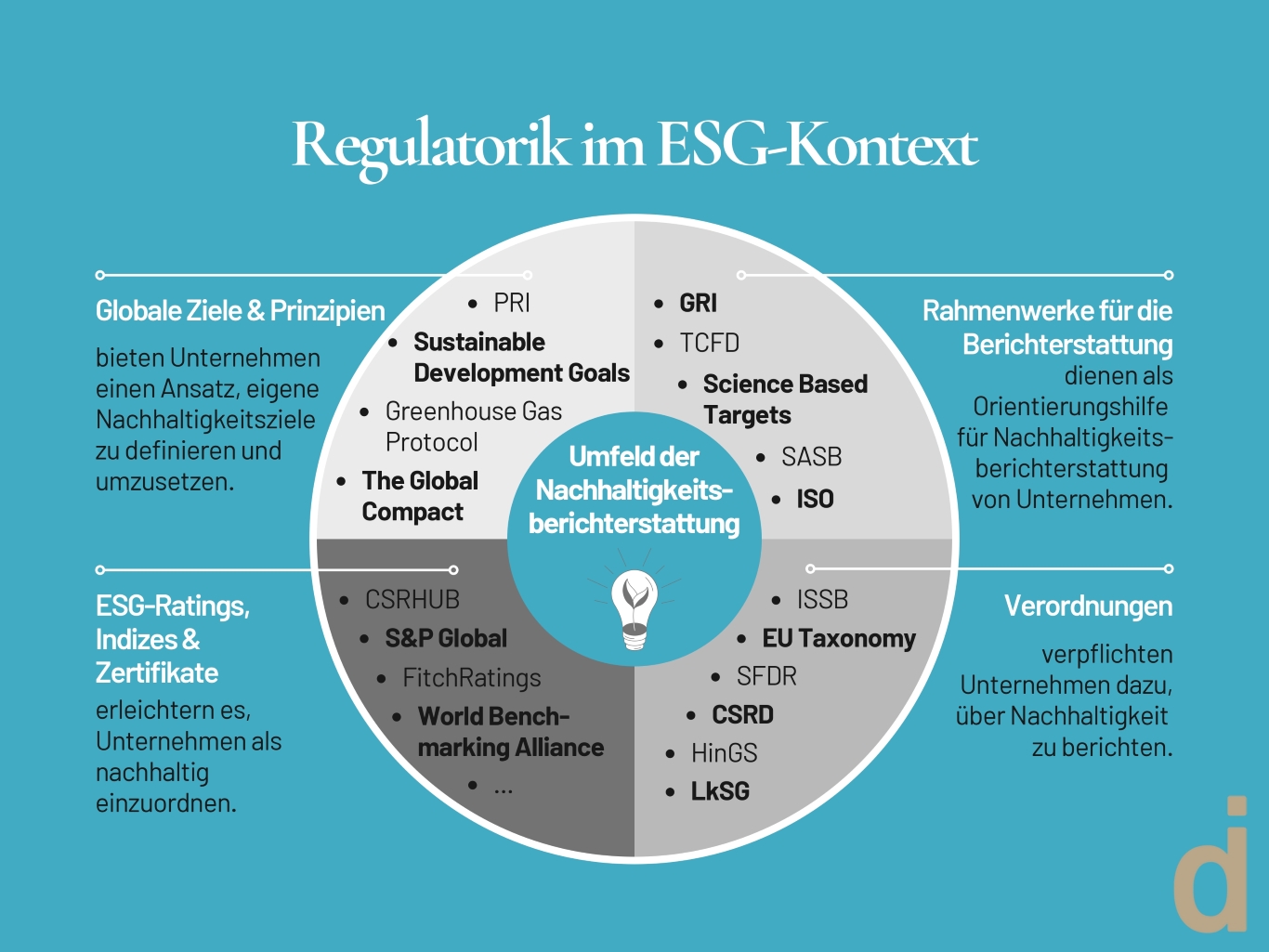
The ESG regulatory framework consists of four main areas. (© Deutsche Interim AG, created with Canva)
Why is the topic of sustainability, especially with regard to ESG, becoming increasingly relevant for companies? And for which companies is it particularly important?
KR: The fact that sustainability and ESG are becoming increasingly important is due to a combination of regulatory pressure, market requirements, investor preferences, risk management and reputation management. The topic is particularly relevant for large companies, resource-intensive industries, financial service providers and consumer goods and technology companies. It also plays an important role for SMEs, for example with regard to international business relationships.
In addition, since 2021, it is no longer only capital market-oriented companies that are required to report on their sustainability, but all large companies that meet two of the following three criteria: a balance sheet total of over 25 million euros, a net turnover of more than 50 million euros and more than 500 employees. With the new "Corporate Sustainability Reporting Directive", the EU will oblige many more companies than before to prepare sustainability reports. From January 2026, small and medium-sized enterprises will also be required to report if they have ten or more employees and are capital market-oriented.
 If SMEs know their target groups for ESG reporting, they have a clear advantage. (© Deutsche Interim AG, created with Canva)
You have already indicated that ESG-compliant companies have competitive advantages now and in the future. What are they?
KR: ESG-compliant companies have several potential competitive advantages. Here are seven examples:
- Risk mitigation: Companies that have implemented ESG for themselves are better protected against environmental accidents and the associated damage to their image, among other things.
- Cost savings: You benefit from resource efficiency and reliable supply chains.
- Reputation: Because of their environmentally friendly brand image, the public has a more positive perception of ESG-compliant companies, which leads to greater customer loyalty.
- Easier access to capital: More and more financiers are attaching importance to sustainable investments, such as ESG-oriented funds and green bonds.
- Regulatory advantages: If companies already apply ESG practices, they are better prepared for future regulatory changes and thus avoid possible sanctions.
- Employee retention and satisfaction: ESG-compliant companies invest in fair and safe working conditions, which is associated with higher productivity, lower employee turnover and reduced recruiting costs.
- Innovation power: Companies that adopt ESG practices are looking for new ways to develop novel services and products that respond to the growing demand for green solutions.
This and more makes ESG-compliant companies more stable and successful on the market in the long term.
All beginnings are difficult: How can SMEs get started with sustainability? What are the first steps? And what measures should be implemented in the long term?
KR: First of all, companies should raise awareness and secure their commitment to sustainable business practices. To ensure they don't lose their way in the dense regulatory jungle, I advise companies to focus on the regulations that are relevant to them. That way, they don't run the risk of reporting everything twice and three times. To do this, it is advisable to start with an inventory. The next step is a double materiality analysis, which companies should ideally not carry out alone at their desks, but in consultation with internal and external stakeholders, for example in the form of expert interviews or small workshops.
In contrast to widespread assumptions, companies are completely free to pick out a few of the 17 United Nations Social Development Goals (SDGs) that fit their corporate strategy or in which they are already successful. The aim is to identify gaps. These usually result from existing data sources. This helps companies immensely to filter out the non-essentials and focus on the essentials. Based on this, a data logic is defined from which the ESG reporting is derived.
How can interim managers help SMEs with sustainability and ESG issues?
KR: While large companies have been setting up entire sustainability departments for some time, this is difficult for SMEs to do. This is because they often lack the expertise and resources in their own workforce that are needed to keep pace with rapidly changing requirements. At the same time, large consulting firms have adapted to the needs of small and medium-sized enterprises with regard to sustainability. However, the effort and costs are often disproportionate for SMEs and such consulting is not affordable overall. Consultancy firms also insist on the need for special ESG software, which also comes at a high cost and needs to be fed with meaningful data.
As a result, SMEs put off ESG reporting for an unnecessarily long time instead of tackling the issue quickly and unbureaucratically. This is where interim managers can play to their strengths. They are the ideal support for pragmatically tackling and successfully mastering the complex requirements in the area of sustainability. Often, numerous data sources are already available in the company that create the basis for a sustainability report. For example, statements on diversity, fluctuation rates, gender-specific salary ratios etc. can be derived from personnel lists, which contribute significantly to the ESG pillar "Social". With their extensive sustainability experience from various industries, interim managers - similar to tax consultants or other external specialists - can quickly support small and medium-sized companies in evaluating, defining and, of course, achieving their sustainable ESG goals.
💡Our recommendation
Read our free brochure Connected Workforce: Interim management for a connected workforce to find out what the Connected Workforce is all about and why the concept is also a promising solution for ESG and sustainability projects.
This sounds easier than you might think. In the media, sustainability reports are often described as an expensive and pointless obligation that resembles a bureaucratic nightmare. What do you think about this?
KR: It cannot be denied that sustainability reports are often perceived as time-consuming and costly. But that is only one side of the coin. Producing them naturally requires resources. But the benefits outweigh the initial outlay. After all, sustainability reports not only contribute to transparency and trust towards customers, investors, employees and the general public. With a view to compliance and risk-management, companies are also better prepared for ESG challenges and the associated risks. In addition, companies strengthen their own innovative power by entering new business areas in the field of sustainability. In the best-case scenario, a company even develops into an innovation leader. Through an efficient and strategic approach, supported by interim managers using appropriate tools and resources, companies can maximize the value of their sustainability reports and have a positive impact on their business strategy and environmental performance.
How do you see the future development of sustainability in companies? Is it just a fleeting trend or will the whole topic continue to gain momentum?
KR: Sustainability is becoming an integral part of corporate strategy and management. On the one hand, there are the regulatory developments that will become increasingly stringent in order to counteract climate change and achieve the EU-wide climate targets. These will inevitably lead to greater transparency and accountability for Europe's major industrial companies, including small and medium-sized enterprises. On the other hand, there is increasing pressure on companies from their own customers, employees and investors to create long-term value.
Is there anything you would like to pass on to companies dealing with sustainability?
KR: One thing is certain: companies that fully integrate sustainability into their business models will be successful in the long term and make a positive contribution to society and the environment. In view of the benefits, I can only advise small and medium-sized companies to get serious about ESG today rather than tomorrow - true to Mahatma Gandhi: "Our future depends on what we do today."
Mrs. Rohmer, thank you for your extensive insights and numerous tips! Are you looking for a suitable solution for a sustainability and ESG project? Feel free to contact us at any time!