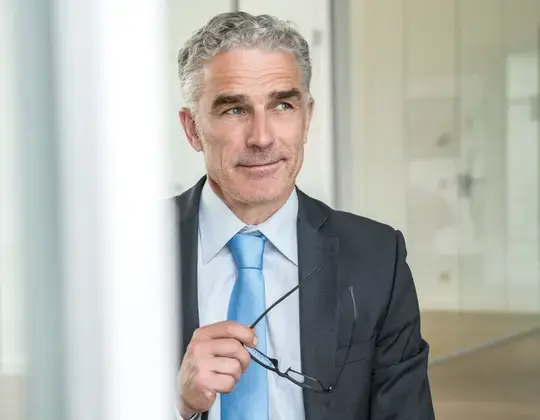
More about the interim manager
The freelance interim manager and consultant specializes in service and sales (direct sales, after sales, technical customer service). He supports companies in critical phases of growth and change. He can look back on more than 15 years of experience in service and sales as well as more than ten years in the management of well-known companies (corporations and SMEs). As an executive and interim manager, he designs sustainable transformation and increases the efficiency of service and sales units. He has repeatedly managed the turnaround of sales units and led critical integration projects to success. in 2018, he was awarded the Interim Management Excellence Award.
The interim manager feels most at home when things "get down to business" in the success-critical areas of service and sales. He likes to work where he can put the customer at the center. With his concepts for realignment and reorganization, he ensures transformation and efficiency.
His personal strengths lie in his independent, methodical and strategic approach - coupled with high personal standards in terms of results, leadership and responsibility. The interim manager has a broad range of theoretical and practical expertise in project management. He manages complex and success-critical projects in a target- and time-oriented manner, even under high pressure to succeed. His leadership training (including at the European School of Management and Technology, Berlin, and the European Business School/ESSEC, Mannheim) enables him to involve managers, employees and external partners in the realignment in a profit- and solution-oriented manner, even in critical phases.
In principle - and especially in the case of change in the course of digitalization - it is important to him to involve the people in the company. He is very aware that employees are the key to success. And that people can only develop their potential if they feel connected to a cause and can make their contribution. In addition, digitalization in particular shows that one person alone cannot master complexity. It will therefore be even more important in the future to successfully shape cultural change in companies.