The planning of an M&A transition already begins in the preparatory phase of signing the transaction. It is initially based on
- the strategy of the buyer,
- the objectives, he is pursuing with his investment, and
- the information that the seller has provided in this phase, the due diligence.
In this phase, it makes sense to define two categories of workflows:
- Carve-out workflows: The operational transition, which consists of ensuring the continuity of the business at the time of the change of ownership (closing). The preparation of this phase is logically the responsibility of the seller in coordination with the buyer.
- Carve-in workflows: The preparation of this phase is logically the responsibility of the buyer, depending on its strategy. The role of the purchased entity depends both on the buyer's possible wishes and on the seller's willingness to provide further information beyond that covered in the due diligence process.
The aim is to prepare a variety of processes in the pre-closing phase, i.e. between signing and closing, and to carry them out in the post-closing phase immediately after the actual transfer of ownership. The duration of the pre-closing phase is usually very short, especially in relation to the scope of the workflows to be prepared. After all, it is in the buyer's interest that the closing proceeds without obstacles and as quickly as possible.
Sales departments are central to workstream outcomes
Sales departments play a central role among the numerous workstreams managed by each function - both in the strategic and tactical preparation and in the operational implementation of the targeted business development conditions. Failure to deliver adequate workstream results within the required lead times can have serious consequences, for example,
- M&A project milestones are delayed in the short term,
- delivery bottlenecks occur,
- customers are unable to make payments,
- the expected business development and/or business optimization targets are not achievable in the medium term or
- the market reputation is damaged.
Milestones and workstreams
The milestones of an M&A project are as follows:
- In the case described below, the kick-off refers to the owner's decision to sell the unit in question and thus to look for potential buyers. However, the presentation of the workstreams during the due diligence phase remains very similar when the search for entities to be purchased and thus the selection of potential candidates and the formulation of proposals begins at the initiative of the buyer.
- Signing means the contractual agreement on the terms of the transaction. The purchase agreement sets out the conditions for completion and for a possible exit, as well as the respective rights and obligations in the planned transfer of ownership. No transfer of ownership takes place at this stage.
- Closing denotes the completion of a transaction and the transfer of ownership: the point in time at which the purchaser - after all contractually agreed closing conditions have been met and payments have been made - actually takes possession of the assets or the business unit.
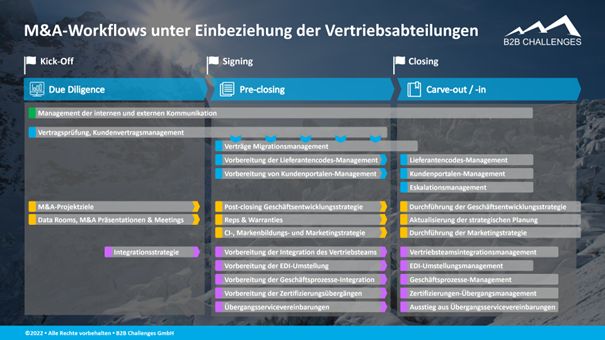
The workstreams, which particularly involve the sales departments, can be assigned to four areas:
- Communication (green)
- Contract transitions (blue)
- Strategic implementation (yellow)
- Integration (purple)
In the following, I would like to look at the most important aspects of each of these workstreams:
1. Control the communication processes.
The communication processes should be controlled carefully in all phases of the M&A project in order to avoid uncontrolled dissemination of confidential information. If sensitive information gets to the wrong recipients, this can hinder the progress of the workstreams - with the serious consequences mentioned above.
The pre-closing phase between the letter of intent and the actual completion of the transaction is certainly the most intensive in terms of communication: all the measures described below are planned, discussed and implemented in this usually very short phase. In order to control the communication of sensitive information, it should be the responsibility of the M&A teams to determine what information is to be passed on when and to whom.
With regard to external communication, the sales departments then have the task of carefully communicating the intended information to customers and reporting on their reactions. In contrast, the managers of all departments must continuously ensure that internal communication reaches all employees efficiently in accordance with the specifications of the M&A teams.
2. Prepare the migration of contracts.
During the entire M&A process, the contractual details of the unit to be sold remain confidential until the transaction is finalized, i.e. the closing. The processes relating to these contracts are logically the responsibility of the company offering the unit for sale: Potential buyers only receive general information, meetings between different stakeholders and experts remain strictly regulated.
However, the contract takeover must be initiated. How should you proceed?
Determine the conditions for a contract takeover
From the signing, the conditions for the migration of the contracts to the new potential owner must be prepared. This includes all negotiation and formalization steps between the seller, the buyer and each customer, which are finally confirmed by the signing of Three-Party Trade Agreements. The content of these agreements may
- depend on the type of transaction (share or asset deal) and
- on special clauses, desired by one party and agreed with the other parties.
The trade agreements are usually signed prior to the closing of the transaction and by definition come into force on the date of the closing of the transaction. If some trade agreements cannot be agreed and signed at the time of closing, the buyer and any affected client will need to deal urgently with interim arrangements that allow the contracts to be executed until the final trade agreements are signed.
Negotiating trade agreements
Negotiating trade agreements is often a significant challenge. The main reasons for this are:
- Large number of existing customers: In most cases, the unit for sale has several dozen customers.
- Lack of time: The target date for the closing is predefined from the signing. The time available for the conclusion of agreements is therefore strictly limited.
- Approvals: The disclosure of information to be included in the trade agreements must be approved by each client in advance, as part of their content (e.g. prices or special conditions) is included in the trade agreements. Prices or special conditions) is considered confidential at this stage between the transferring entity and the customer.
- Customer interests: Customers represent their interests and may seek to impose conditions that did not previously apply (e.g. their latest terms and conditions). In this context, it should be noted that a stalemate scenario is not in the customer's interest as it could jeopardize transaction confirmation deliveries.
- Existing business relationships: In some cases, the acquirer already has business relationships with some of the customers and may have agreed terms and conditions with them that differ from those of the entity in transition.
- Insolvency proceedings: When taking over an insolvent company, the interests represented by the insolvency administrator may be contrary to the terms sought by the parties.
- Delays caused by legal counsel: Parties are often required to involve their legal departments in negotiating the terms of a trade agreement, which often increases the time it takes to address and resolve certain challenges.
Assigning new supplier codes
In addition to contract terms, two other issues require special attention. One of these is preparing for the migration of supplier codes. The need for new supplier codes depends on the customer's procedures. The customer-specific processes for assigning new supplier codes are often time-consuming and complex. Typically, each site of the entity preparing for the transition has its own processes.
However, the proper functioning of numerous operational aspects that are critical to maintaining business operations on the day after closing depends on them being granted. These include
- EDI communication between the customer and its supplier, i.e. electronic transmission of delivery schedules, delivery data and invoicing, but also
- access to the customer portal, which often forms the basis for important collaboration processes and the exchange of key data and documents.
The second factor that determines the need for new supplier codes is the category under which the transaction falls:
- For example, are the seller's entities merging with the new owner's entities?
- Is it an asset or share deal, for example?
- Is the new owner's corporate structure and locations perhaps already registered in the customer's supplier database?
- Or does the vendor still need the supplier codes of the current entities to continue doing business with the customer?
Certain customers, most notably some automotive manufacturers, link or base their vendor codes on the references and company information from Dun & Bradstreet. D&B is an independent company where new prospective information about the business for sale and its locations must also be reported in order for it to obtain the required DUNS numbers.
In extreme cases, customer-specific processes for approving new supplier codes may prove incompatible with the closing schedule, requiring increased engagement with affected customers.
Securing information about the pre-closing situation
The second topic that requires special attention alongside the contract terms is the customization of customer portals, i.e. customer-specific secure websites that contain modules for
- the exchange of business-specific documents (e.g. procedures, orders, orders, data, etc.).
- and
The following dilemma needs to be solved in order to adapt these portals: On the one hand, employees who use these portals need new access as soon as they close. At the same time, employees who remain with the vendor must no longer be able to access data from the customer portal. On the other hand, the information that these portals contain about the pre-closing situation must not be lost when the customers themselves receive new supplier codes.
Saving such information is usually a lengthy process that can only be solved in collaboration with the customer. After all, the various modules of these portals are often based on certain terms and conditions - e.g. the creation of an order if the supplier misses the response deadline - which can have an impact on operational and financial processes. It is therefore essential to agree existing terms and conditions with the buyer and negotiate changes with customers if necessary.
Between signing and closing, a concrete strategy for the customer portals must therefore be developed, which includes the following aspects:
- the list of customer portals or customer portal modules, that will be released before the closing
- the potential consequences of a merger
- the consequences of the migration of supplier codes
- the structure and guidelines, that should apply after the closing
Only with such a strategy can the migration of the customer portals and the migration of the supplier codes be implemented immediately after the closing.
3. Prepare the further development of the business plan.
While the responsibility for the previous topic lies primarily with the company being sold, the responsibility for the strategy behind the acquisition and its safeguarding naturally lies with the buyer. From a business and commercial perspective, the strategy is initially developed on the basis of the acquisition targets and the interpretation of the information obtained during the due diligence phase from data rooms, management presentations, expert sessions and the like. During the pre-closing phase, the buyer will further develop its post-closing business development strategy and, if applicable, its brand and marketing strategy.
But: Until the transaction is fully consummated (closing), the buyer will not have access to the resources of the target company to refine these plans - unless the seller authorizes such support.
Complexity of actions determines deadline
The time period between the signing and closing milestones depends in particular on the number and complexity of actions required to ensure the terms of the purchase agreement are met. This period can be several months. During this period, the seller's business will continue and events may occur that affect the assumptions underlying the buyer's business case. The seller is required to explain such differences in a document called "Reps & Warranties", which is presented to the buyer when the transaction is confirmed. Among other things, it must contain all information about potential discrepancies in terms of customer situations and business volumes.
After closing: updating the business plan
After closing, the teams of the merging business development and sales departments will actively cooperate to update and implement the business plan.
4. Integrate the teams and processes.
The integration of teams and processes into your own company affects all departments. But in the case of sales departments, proceed as follows:
Reorient the sales teams
The aim of integrating the sales departments is to reorganize the teams and align them with the new sales administration and new customer interfaces after the merger. A transformation plan can be helpful here. It can make it easier for newcomers
- to adopt the company's vision and mission and
- to internalize the new corporate culture.
Integrating the EDI system into your own IT infrastructure
Without a doubt, integrating the seller's EDI system into your own IT infrastructure is crucial to the success of an M&A project. Integration may require changes to EDI protocols, which must then be coordinated with the customer's corresponding processes. However, the integration of the EDI system can also become part of the post-closing phase, namely when it is agreed in a special transition service agreement that the entity being sold will continue to use the seller's EDI system on a transitional basis. This makes sense if the buyer is not in a position to fully integrate the EDI system in the often short pre-closing phase.
Integrating operating processes holistically
In order to ensure that the operating processes of the unit to be acquired can be integrated into the company as quickly as possible after closing, the integration of the processes, including their digital tools, must be planned and prepared thoroughly and comprehensively. For the sales and marketing departments, the planning and preparation will include these aspects, among others:
- customer relationship and customer satisfaction management
- sales planning
- business acquisition management
- contract management including contract reviews
- pricing management
- customer master data management
- the management of customer portals
- the ERP and CRM systems
Prepare recertifications
It is clear, that the unit for sale must confirm its certifications - such as the IATF 16949, ISO 9001 or ISO 14001 standards - at the next recertification audit. For the sales department, this means having to clarify all processes for which it will be responsible in the new structure - even if only temporarily - and ensure that its activities are also compliant under the new framework conditions.
Agreing the continuation of services
As with the integration of EDI systems mentioned above, the buyer and seller can also agree for certain services that the seller will continue to offer them on a transitional basis if it becomes apparent that the buyer will not be able to ensure the performance of these services until closing.
Such agreements, the so-called Transition Service Agreements (TSA), determine
- the services to be continued,
- the context in which they are to be provided and
- the duration of the TSA, which is usually several months.
Sales departments in particular often require such agreements, as the pre-closing phase is usually too short to organize the takeover of services such as the handling of customer issues or the use of certain logistics channels.
Conclusion: Professionalism is the key to successful M&A workstreams
Professionalism and expertise are key elements of the successful implementation of M&A workstreams. Because only if you are able to deliver adequate results within the set deadlines can you avoid serious negative consequences such as
- unplanned costs for corrective actions,
- delayed closing
- and - in the worst case - delivery stops and loss of market reputation
.
Required resources must be available
In order to implement the individual M&A workflows safely, it is therefore essential to provide all the necessary resources. It is therefore advisable to set up a central task force. This team would coordinate the individual workstreams and allocate the necessary resources, and would be responsible for any conflicts that may arise before or after closing if the transaction has not been completed in full.
Pragmatic solution: strengthening the team for the critical phase
If expertise and/or industry-specific specialist knowledge is not available in-house, strengthening the team with experienced interim managers can be a quick and unbureaucratic solution.
Just get in touch with me - I would be happy to advise you!